
by Elli Schochet, CPF
Preserving wealth across generations demands a clear understanding of how assets are treated at the end of life. For Canadian families with significant holdings, capital gains tax at death remains one of the most consistent and often underestimated sources of estate erosion. When appreciated assets are deemed disposed of, the resulting tax liability can strain liquidity, complicate succession plans, and diminish the value ultimately intended for heirs.
Families with operating companies, real estate portfolios, or hard assets face these pressures most acutely. The challenge is not only recognizing where exposure exists, but ensuring that planning anticipates the tax impact well before the estate is settled. Thoughtful preparation, disciplined structures, and the right tools can make a meaningful difference in protecting the legacy that families work hard to build.
Understanding how capital gains tax erodes estate value
In the broader context of wealth transfer in Canada, capital gains tax is one of the most predictable drivers of estate erosion for families with significant assets. At death, the CRA generally treats most assets as though they were sold the day before death. Any accrued gains are realized at that point, and the resulting tax liability becomes payable by the estate.
For families who have accumulated assets over decades, this can result in a substantial tax bill arising in a single year. The challenge is not only the size of the liability, but its timing. Capital gains tax is triggered immediately, often before assets can be sold, refinanced, or reorganized. Because the tax must be paid in cash, estates holding illiquid assets may face pressure to sell property or business interests quickly, sometimes during unfavourable market conditions. Delays in selling can expose the estate to market declines, further reducing value at a critical moment.
These risks are particularly pronounced for families with operating companies, real estate portfolios, or legacy investments. While spousal rollovers may defer tax in certain circumstances, they do not eliminate the liability. Where a rollover is unavailable, the estate must fund the tax directly. If assets cannot be sold efficiently or markets are volatile, families may be forced to make decisions that conflict with their long-term intentions for the business or family legacy.
Common planning gaps and misconceptions
Many families underestimate their exposure to capital gains tax because planning often focuses on income tax efficiency during life rather than tax consequences at death. Unrealized gains on long-held assets are frequently overlooked, particularly where appreciation has occurred gradually over time.
Another common assumption is that assets can simply be sold later to cover taxes. In practice, liquidity and timing matter. Selling a business, real estate holding, or private investment may take time, and market conditions at the time of death can materially affect the realized value. Without sufficient liquidity, estates may be forced to sell or refinance assets at unfavourable terms.
Delayed planning also increases risk. When discussions are postponed until health concerns arise or time becomes limited, fewer strategies remain available. While certain post-mortem planning approaches may help reduce unintended double taxation in specific circumstances, they are often complex, constrained by existing structures, and less flexible.
Assets that create the greatest liquidity pressure
Liquidity strain most often arises when assets are valuable but not easily converted to cash. Private company shares frequently fall into this category, particularly where there is no immediate market or succession plan in place. Income-producing real estate may carry significant accrued gains while generating limited short-term cash flow. Family cottages and other legacy properties can present similar challenges when heirs wish to retain them rather than sell.
In each case, the issue is not the quality of the asset, but the mismatch between when tax is due and when cash is available.
The strategic role of insurance in estate planning
Addressing capital gains risk requires coordination across tax, estate, and liquidity planning, which is why insurance often works in tandem with legal and accounting strategies rather than in isolation. Life insurance provides immediate liquidity at death, allowing capital gains tax to be paid without forcing the sale of core assets. This can be particularly valuable where families wish to preserve businesses, properties, or legacy assets for future generations.
Insurance can also support estate equalization when some assets are illiquid or intended to be retained by certain heirs. In corporate planning, when structured properly, insurance can be used to release trapped surplus from a corporation with little to no tax, improving liquidity and reducing pressure on the estate. Integrated thoughtfully, insurance helps stabilize outcomes at death while protecting overall estate value.
Clarity and an early start
The most important step families can take to reduce future estate erosion is to begin with a clear, consolidated understanding of their assets and the tax implications that will arise at death. Because the CRA treats most assets as though they were sold the day before death, identifying unrealized gains and estimating future tax liabilities is essential.
Early engagement with professional tax and estate advisors enables families to assess liquidity gaps, evaluate structural options, and consider appropriate tools, including trusts, estate freezes, post-mortem planning, philanthropic giving, and insurance coverage. Beginning early preserves flexibility, enabling strategies to evolve over time as asset values, family circumstances, and tax rules change.
With disciplined, forward-looking planning, families can protect what they have built and ensure future generations receive the full benefit of that work.
Contact Elli Schochet, CFP, at eschochet@algbrown.com to explore your planning options.
Sign up here and receive news and insights directly into your inbox.
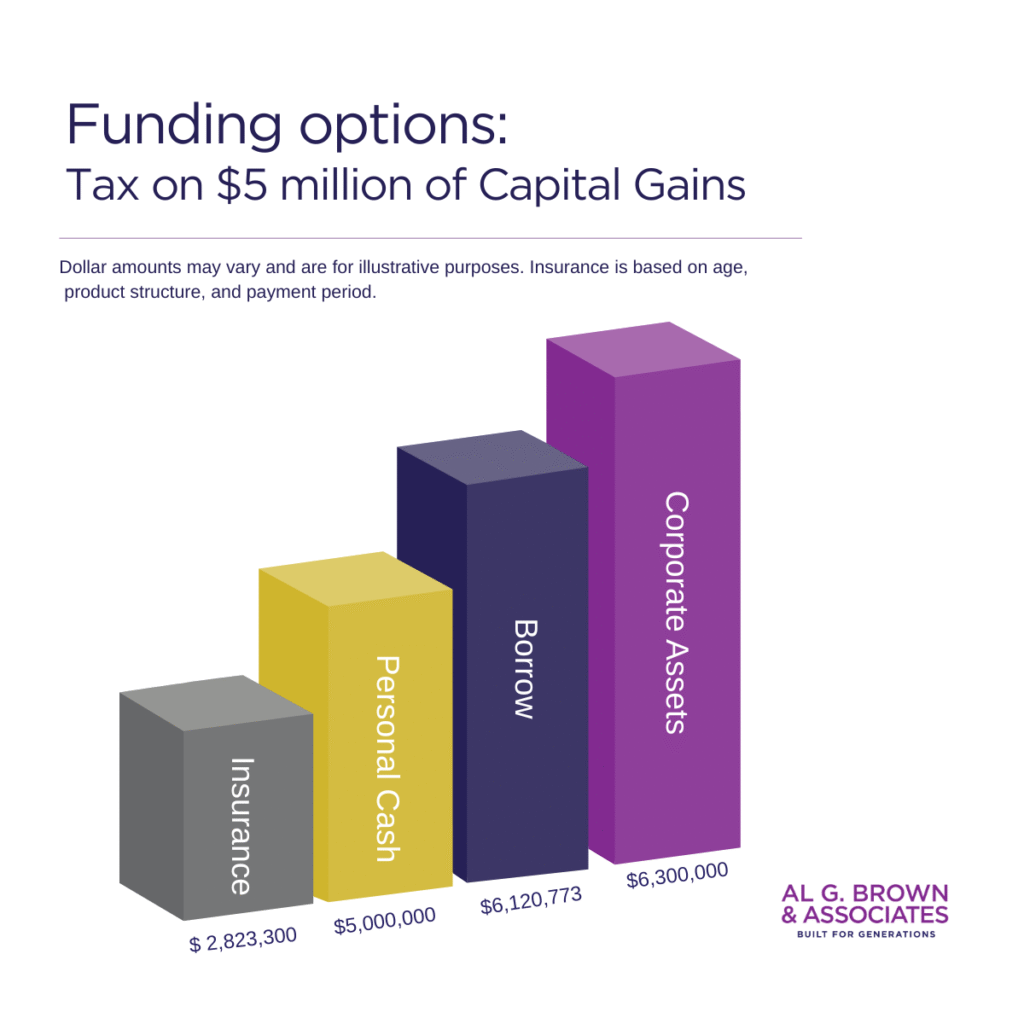
Comparing funding options highlights the cost of liquidity at death.
Using personal cash, borrowing, or extracting corporate assets can significantly increase the total cost of funding a capital gains tax liability. While the cost of life insurance varies based on age, product structure, and payment period, it is consistently lower than these alternative funding approaches and provides liquidity when it is needed most.